2026
Scalable Origin-Destination Travel Time Estimation via Landmark Approximation and Neural Residual Correction
Joon-Seok Kim, Lina Li, Jooyoung Yoo, Kiara Ha, Parker Wischhover, Hossein Amiri, Taozhi Chen, Andreas Züfle
Under review. Aug 2026
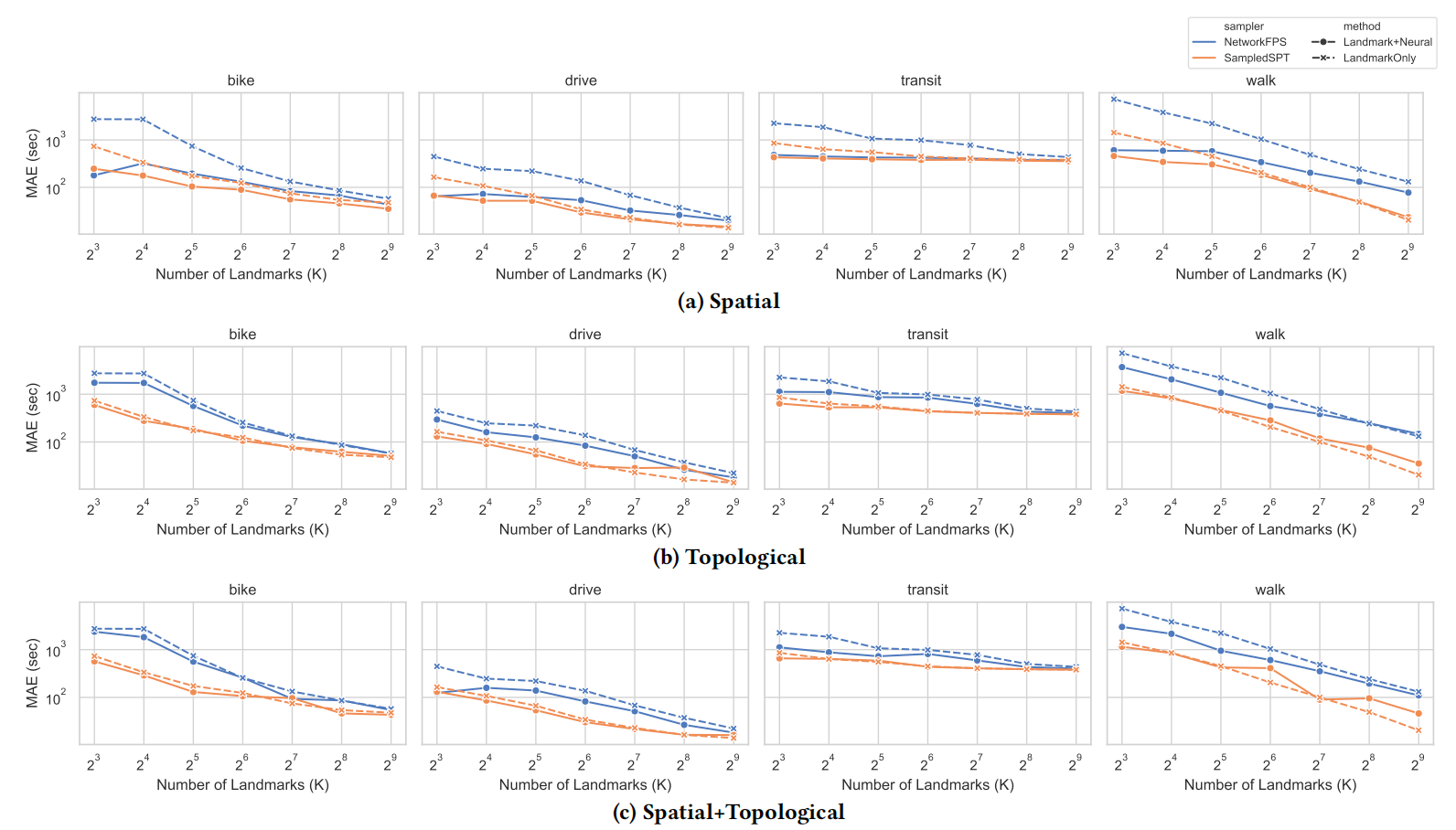
Estimating travel times between all origin-destination (OD) pairs is a fundamental problem in transportation analysis, but remains challenging due to quadratic scaling, network constraints, and computational cost. Most existing approaches focus on route-level estimation or rely on repeated shortest-path queries, limiting their applicability to large-scale OD matrix construction. This paper formulates OD travel-time estimation as a landmark-based approximation problem and proposes a scalable framework that combines graph-based preprocessing with neural residual correction. Landmark-based methods enable efficient inference with time complexity linear in the number of landmarks, but exhibit diminishing returns as the landmark budget increases. To fill the gap, we introduce a lightweight neural model that learns systematic approximation error from spatial and structural features. Experiments on large multimodal transportation networks demonstrate that neural residual correction consistently reduces travel-time error and enables comparable or better accuracy with substantially fewer landmarks. As a result, the proposed approach improves the accuracy-memory-latency trade-off relative to purely landmark-based methods, particularly in large and high-diameter networks.
Scalable Origin-Destination Travel Time Estimation via Landmark Approximation and Neural Residual Correction
Joon-Seok Kim, Lina Li, Jooyoung Yoo, Kiara Ha, Parker Wischhover, Hossein Amiri, Taozhi Chen, Andreas Züfle
Under review. Aug 2026
Estimating travel times between all origin-destination (OD) pairs is a fundamental problem in transportation analysis, but remains challenging due to quadratic scaling, network constraints, and computational cost. Most existing approaches focus on route-level estimation or rely on repeated shortest-path queries, limiting their applicability to large-scale OD matrix construction. This paper formulates OD travel-time estimation as a landmark-based approximation problem and proposes a scalable framework that combines graph-based preprocessing with neural residual correction. Landmark-based methods enable efficient inference with time complexity linear in the number of landmarks, but exhibit diminishing returns as the landmark budget increases. To fill the gap, we introduce a lightweight neural model that learns systematic approximation error from spatial and structural features. Experiments on large multimodal transportation networks demonstrate that neural residual correction consistently reduces travel-time error and enables comparable or better accuracy with substantially fewer landmarks. As a result, the proposed approach improves the accuracy-memory-latency trade-off relative to purely landmark-based methods, particularly in large and high-diameter networks.

Fleet Capacity and Operational Coverage in Autonomous Transportation for Rural Healthcare Acces
Joon-Seok Kim, Su Han, Taozhi Chen, Jooyoung Yoo, Youjeong Kang, Andreas Züfle
Under review. Aug 2026
Transportation barriers can limit rural healthcare access even when appropriate services are geographically available. This study develops a data-driven stochastic operational simulation for healthcare demand-responsive transportation in the 15-county South Plains region of Texas. Public aggregate data describe tract populations and disability, healthcare facilities, and road-network travel times; patient trips, appointment availability, and current transit waiting times remain assumed rather than observed. Eight primary scenarios and seven controls or sensitivities were evaluated with 100 replications each. The eight-vehicle autonomous reference completed 77.2% of requests with a 10.5-minute mean wait. Reducing the fleet to four vehicles decreased completion by 12.1 percentage points, while 12 vehicles increased it by 2.8 points. Restricting eligible routes by a travel-time coverage rule decreased completion by 13.1 points. An equal-size hybrid with six autonomous and two human fallback vehicles recovered 11.2 points relative to restricted autonomous service. Standard, wheelchair, and assistance-request completion in the autonomous reference was 81.5%, 66.0%, and 48.4%, respectively. When route coverage was matched, human and autonomous fleets produced identical service outcomes; their modeled cost difference depended entirely on hourly labor or supervision assumptions and disappeared at $25 per autonomous operating hour. The findings identify fleet coverage and accessible-service capacity as pilot-design priorities, but do not constitute empirical validation of current transit performance or automated-road suitability.
Fleet Capacity and Operational Coverage in Autonomous Transportation for Rural Healthcare Acces
Joon-Seok Kim, Su Han, Taozhi Chen, Jooyoung Yoo, Youjeong Kang, Andreas Züfle
Under review. Aug 2026
Transportation barriers can limit rural healthcare access even when appropriate services are geographically available. This study develops a data-driven stochastic operational simulation for healthcare demand-responsive transportation in the 15-county South Plains region of Texas. Public aggregate data describe tract populations and disability, healthcare facilities, and road-network travel times; patient trips, appointment availability, and current transit waiting times remain assumed rather than observed. Eight primary scenarios and seven controls or sensitivities were evaluated with 100 replications each. The eight-vehicle autonomous reference completed 77.2% of requests with a 10.5-minute mean wait. Reducing the fleet to four vehicles decreased completion by 12.1 percentage points, while 12 vehicles increased it by 2.8 points. Restricting eligible routes by a travel-time coverage rule decreased completion by 13.1 points. An equal-size hybrid with six autonomous and two human fallback vehicles recovered 11.2 points relative to restricted autonomous service. Standard, wheelchair, and assistance-request completion in the autonomous reference was 81.5%, 66.0%, and 48.4%, respectively. When route coverage was matched, human and autonomous fleets produced identical service outcomes; their modeled cost difference depended entirely on hourly labor or supervision assumptions and disappeared at $25 per autonomous operating hour. The findings identify fleet coverage and accessible-service capacity as pilot-design priorities, but do not constitute empirical validation of current transit performance or automated-road suitability.
Multi-agent Collaboration with State Management
Mengyang Liu, Taozhi Chen, Zhenhua Xu, Xue Jiang, Yihong Dong
arXiv May 2026
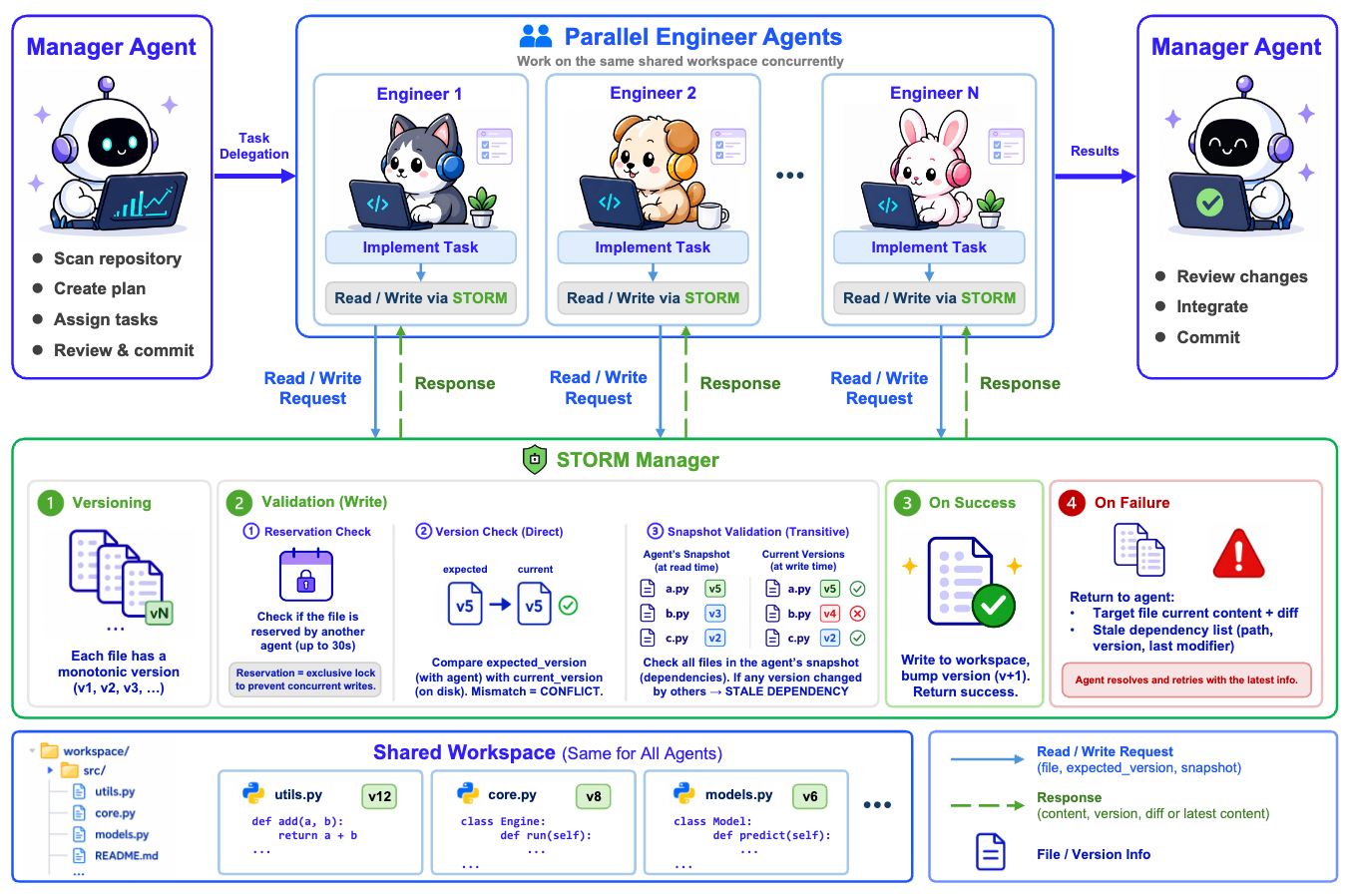
Recent advances in multi-agent systems have shown great potential for solving complex tasks. However, when multiple agents edit a shared codebase concurrently, their changes can silently conflict and inconsistent views lead to integration failures. Existing multi-agent systems address this through workspace isolation (e.g., one git worktree per agent), but this defers conflict resolution to a post-hoc merge step where recovery is expensive. In this paper, we propose STORM, i.e., STate-ORiented Management for multi-agent collaboration. Specifically, STORM manages agent states by mediating their interactions with the shared workspace, ensuring that each agent operates on a consistent view of the codebase and that conflicting edits are detected and resolved at write time.We evaluate STORM on Commit0 and PaperBench across multiple LLMs. STORM outperforms the git-worktree-based multi-agent baseline by +18.7 on Commit0-Lite and +1.4 on PaperBench, while achieving comparable or better cost efficiency. Combined with single-agent runs, STORM reaches highest scores of 87.6 and 78.2 on the two benchmarks respectively, suggesting that explicit state management is a more effective foundation for multi-agent collaboration than workspace isolation. STORM can also be plugged into any multi-agent system.



Multi-agent Collaboration with State Management
Mengyang Liu, Taozhi Chen, Zhenhua Xu, Xue Jiang, Yihong Dong
arXiv May 2026
Recent advances in multi-agent systems have shown great potential for solving complex tasks. However, when multiple agents edit a shared codebase concurrently, their changes can silently conflict and inconsistent views lead to integration failures. Existing multi-agent systems address this through workspace isolation (e.g., one git worktree per agent), but this defers conflict resolution to a post-hoc merge step where recovery is expensive. In this paper, we propose STORM, i.e., STate-ORiented Management for multi-agent collaboration. Specifically, STORM manages agent states by mediating their interactions with the shared workspace, ensuring that each agent operates on a consistent view of the codebase and that conflicting edits are detected and resolved at write time.We evaluate STORM on Commit0 and PaperBench across multiple LLMs. STORM outperforms the git-worktree-based multi-agent baseline by +18.7 on Commit0-Lite and +1.4 on PaperBench, while achieving comparable or better cost efficiency. Combined with single-agent runs, STORM reaches highest scores of 87.6 and 78.2 on the two benchmarks respectively, suggesting that explicit state management is a more effective foundation for multi-agent collaboration than workspace isolation. STORM can also be plugged into any multi-agent system.
Learning from Execution: Self-Evolving Memory for Private-Library Code Generation
Mofei Li*, Taozhi Chen*, Guowei Yang, Jia Li (* equal contribution)
arXiv Apr 2026
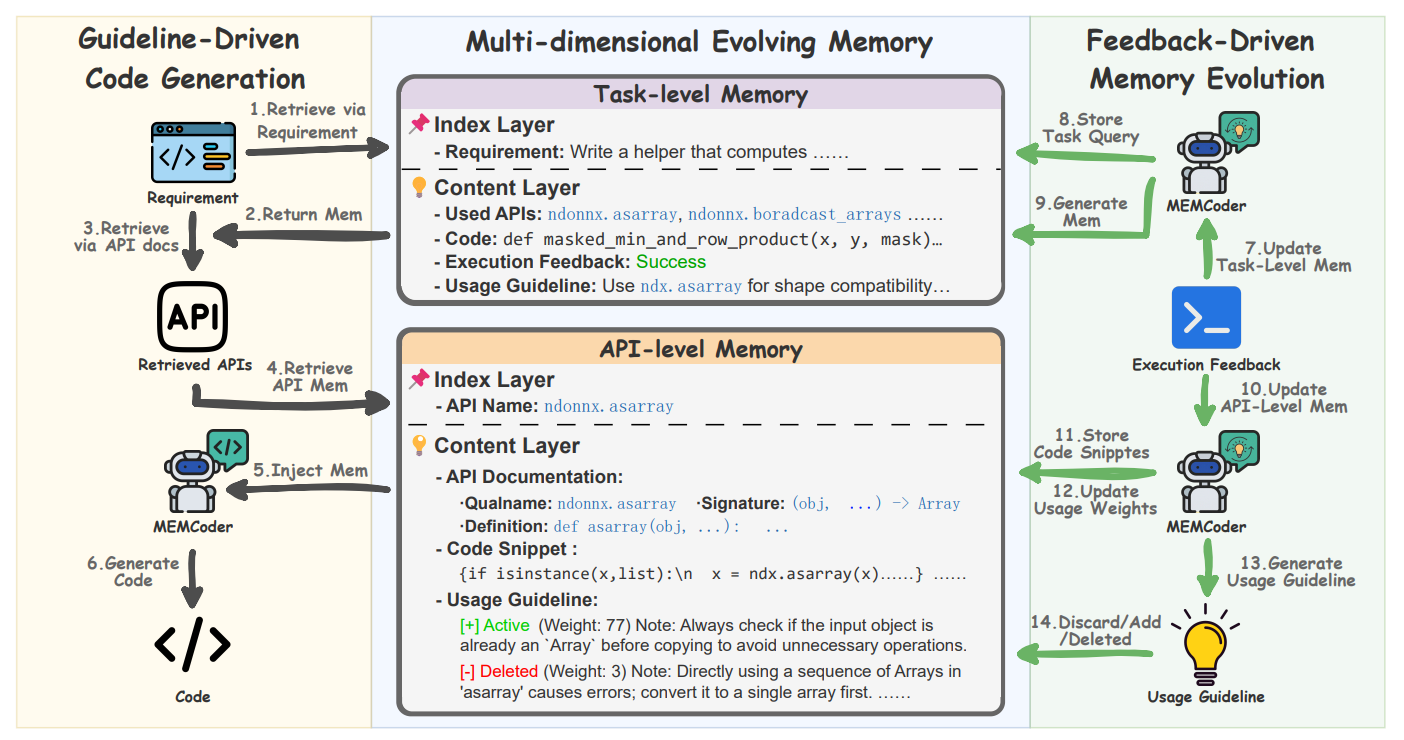
Large Language Models (LLMs) have achieved strong performance on general code generation, but their effectiveness drops sharply in enterprise settings where software development relies on internal private libraries absent from public pre-training corpora. Existing Retrieval-Augmented Generation (RAG) methods provide a training-free solution by retrieving static API documentation, but our analysis shows that documentation mainly helps models identify what APIs to use and remains insufficient for teaching them how to use them correctly. Even with oracle API-document retrieval, LLMs still make recurring errors at the API, cross-API, and task levels, including API misuse or hallucination, flawed API composition, and incorrect solution strategies. To address this limitation, we propose MEMCoder, a training-free self-evolving memory framework for private-library code generation. MEMCoder augments existing RAG pipelines with a Multi-level Evolving Memory that continuously accumulates and reuses execution-derived Usage Guidelines at the API, cross-API, and task levels. During generation, MEMCoder retrieves both static API documentation and relevant historical memories to guide code generation; after execution, it analyzes feedback to refine memory through a closed loop of generation, execution, reflection, and update. Extensive experiments on NdonnxEval and NumbaEval show that MEMCoder consistently enhances different RAG backbones across LLMs of different scales, yielding an average absolute pass@1 improvement of 18.41 percentage points. Moreover, MEMCoder outperforms existing self-evolving memory methods and validates the effectiveness of organizing execution feedback into multi-level usage memories.

Learning from Execution: Self-Evolving Memory for Private-Library Code Generation
Mofei Li*, Taozhi Chen*, Guowei Yang, Jia Li (* equal contribution)
arXiv Apr 2026
Large Language Models (LLMs) have achieved strong performance on general code generation, but their effectiveness drops sharply in enterprise settings where software development relies on internal private libraries absent from public pre-training corpora. Existing Retrieval-Augmented Generation (RAG) methods provide a training-free solution by retrieving static API documentation, but our analysis shows that documentation mainly helps models identify what APIs to use and remains insufficient for teaching them how to use them correctly. Even with oracle API-document retrieval, LLMs still make recurring errors at the API, cross-API, and task levels, including API misuse or hallucination, flawed API composition, and incorrect solution strategies. To address this limitation, we propose MEMCoder, a training-free self-evolving memory framework for private-library code generation. MEMCoder augments existing RAG pipelines with a Multi-level Evolving Memory that continuously accumulates and reuses execution-derived Usage Guidelines at the API, cross-API, and task levels. During generation, MEMCoder retrieves both static API documentation and relevant historical memories to guide code generation; after execution, it analyzes feedback to refine memory through a closed loop of generation, execution, reflection, and update. Extensive experiments on NdonnxEval and NumbaEval show that MEMCoder consistently enhances different RAG backbones across LLMs of different scales, yielding an average absolute pass@1 improvement of 18.41 percentage points. Moreover, MEMCoder outperforms existing self-evolving memory methods and validates the effectiveness of organizing execution feedback into multi-level usage memories.
Think Anywhere in Code Generation
Xue Jiang, Tianyu Zhang, Mengyang Liu, Taozhi Chen, Zhenhua Xu, Wenpin Jiao, Zhi Jin, Ge Li, Yihong Dong
arXiv Mar 2026
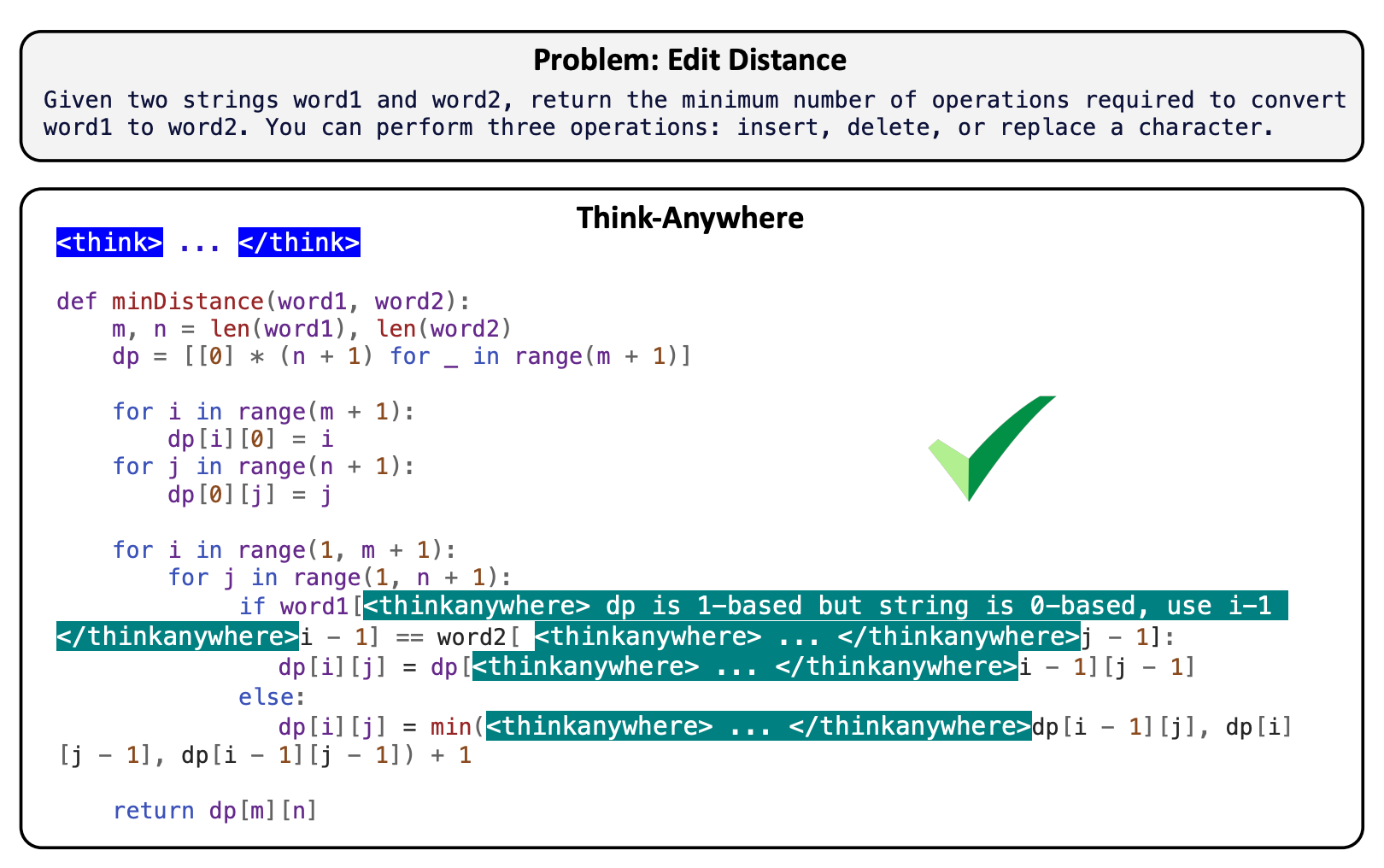
Recent advances in reasoning Large Language Models (LLMs) have primarily relied on upfront thinking, where reasoning occurs before final answer. However, this approach suffers from critical limitations in code generation, where upfront thinking is often insufficient as problems' full complexity only reveals itself during code implementation. Moreover, it cannot adaptively allocate reasoning effort throughout the code generation process where difficulty varies significantly. In this paper, we propose Think-Anywhere, a novel reasoning mechanism that enables LLMs to invoke thinking on-demand at any token position during code generation. We achieve Think-Anywhere by first teaching LLMs to imitate the reasoning patterns through cold-start training, then leveraging outcome-based RL rewards to drive the model's autonomous exploration of when and where to invoke reasoning. Extensive experiments on four mainstream code generation benchmarks (i.e., LeetCode, LiveCodeBench, HumanEval, and MBPP) show that Think-Anywhere achieves state-of-the-art performance over both existing reasoning methods and recent post-training approaches, while demonstrating consistent generalization across diverse LLMs. Our analysis further reveals that Think-Anywhere enables the model to adaptively invoke reasoning at high-entropy positions, providing enhanced interpretability.


Think Anywhere in Code Generation
Xue Jiang, Tianyu Zhang, Mengyang Liu, Taozhi Chen, Zhenhua Xu, Wenpin Jiao, Zhi Jin, Ge Li, Yihong Dong
arXiv Mar 2026
Recent advances in reasoning Large Language Models (LLMs) have primarily relied on upfront thinking, where reasoning occurs before final answer. However, this approach suffers from critical limitations in code generation, where upfront thinking is often insufficient as problems' full complexity only reveals itself during code implementation. Moreover, it cannot adaptively allocate reasoning effort throughout the code generation process where difficulty varies significantly. In this paper, we propose Think-Anywhere, a novel reasoning mechanism that enables LLMs to invoke thinking on-demand at any token position during code generation. We achieve Think-Anywhere by first teaching LLMs to imitate the reasoning patterns through cold-start training, then leveraging outcome-based RL rewards to drive the model's autonomous exploration of when and where to invoke reasoning. Extensive experiments on four mainstream code generation benchmarks (i.e., LeetCode, LiveCodeBench, HumanEval, and MBPP) show that Think-Anywhere achieves state-of-the-art performance over both existing reasoning methods and recent post-training approaches, while demonstrating consistent generalization across diverse LLMs. Our analysis further reveals that Think-Anywhere enables the model to adaptively invoke reasoning at high-entropy positions, providing enhanced interpretability.
What Papers Don't Tell You: Recovering Tacit Knowledge for Automated Paper Reproduction
Lehui Li, Ruining Wang, Haochen Song, Yaoxin Mao, Tong Zhang, Yuyao Wang, Jiayi Fan, Yitong Zhang, Taozhi Chen, Jieping Ye, Chengqi Zhang, Yongshun Gong
arXiv Mar 2026
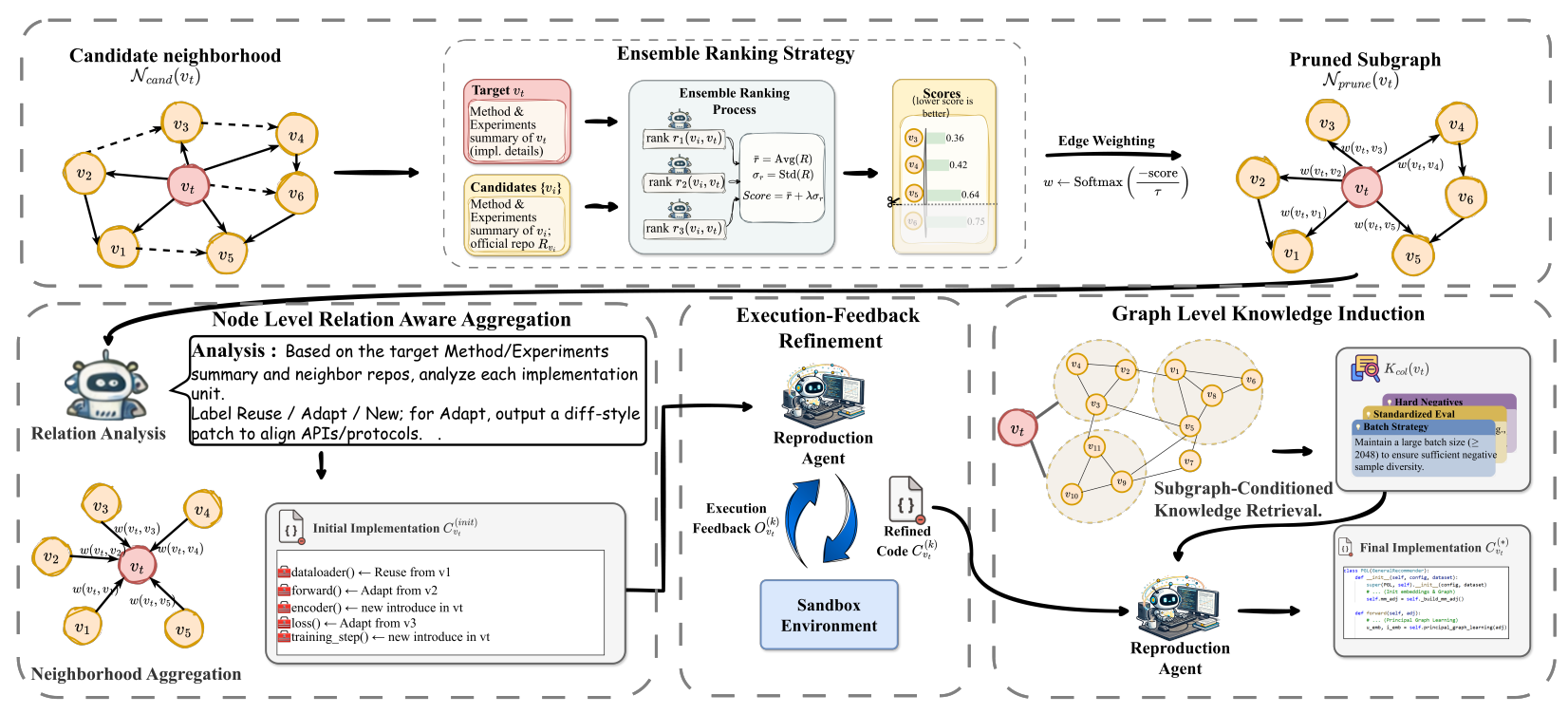
Automated paper reproduction seeks to generate executable code implementations from academic papers, substantially reducing the cost of research validation and reuse while accelerating the accumulation of scientific knowledge. Existing approaches retrieve and concatenate text and code snippets from citation neighborhoods, yet fail to capture the knowledge implicitly encoded in the relational structure among papers. We argue that the knowledge essential for reproduction naturally resides at two distinct levels of the paper graph: (i) globally shared common knowledge within a domain, and (ii) undocumented local aggregation details between the target paper and its predecessor works. To address this, we propose PaperRep, a multi-scale graph reasoning framework that first applies semantic graph pruning to select implementation-relevant nodes from the paper graph, then employs a global graph reasoning module to distill stable reproduction patterns within the domain and a local graph reasoning module to characterize implementation aggregation relationships between the target paper and its neighbors. Extensive experiments on an extended ReproduceBench covering 10 tasks and 40 recent papers show that PaperRep achieves an average performance gap of 10.04% against official implementations, improving over the strongest baseline by 24.68%, thereby validating the necessity and effectiveness of explicit graph-structured reasoning for automated paper reproduction.

What Papers Don't Tell You: Recovering Tacit Knowledge for Automated Paper Reproduction
Lehui Li, Ruining Wang, Haochen Song, Yaoxin Mao, Tong Zhang, Yuyao Wang, Jiayi Fan, Yitong Zhang, Taozhi Chen, Jieping Ye, Chengqi Zhang, Yongshun Gong
arXiv Mar 2026
Automated paper reproduction seeks to generate executable code implementations from academic papers, substantially reducing the cost of research validation and reuse while accelerating the accumulation of scientific knowledge. Existing approaches retrieve and concatenate text and code snippets from citation neighborhoods, yet fail to capture the knowledge implicitly encoded in the relational structure among papers. We argue that the knowledge essential for reproduction naturally resides at two distinct levels of the paper graph: (i) globally shared common knowledge within a domain, and (ii) undocumented local aggregation details between the target paper and its predecessor works. To address this, we propose PaperRep, a multi-scale graph reasoning framework that first applies semantic graph pruning to select implementation-relevant nodes from the paper graph, then employs a global graph reasoning module to distill stable reproduction patterns within the domain and a local graph reasoning module to characterize implementation aggregation relationships between the target paper and its neighbors. Extensive experiments on an extended ReproduceBench covering 10 tasks and 40 recent papers show that PaperRep achieves an average performance gap of 10.04% against official implementations, improving over the strongest baseline by 24.68%, thereby validating the necessity and effectiveness of explicit graph-structured reasoning for automated paper reproduction.
Do Transformers Have the Ability for Periodicity Generalization?
Huanyu Liu, Ge Li, Yihong Dong, Sihan Wu, Peixu Wang, Sihao Cheng, Taozhi Chen, Kechi Zhang, Hao Zhu, Tongxuan Liu
arXiv Jan 2026
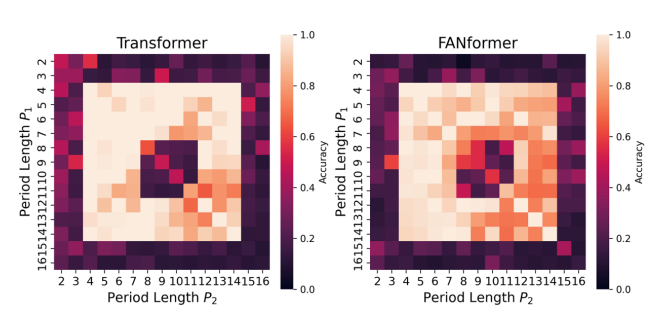
Large language models (LLMs) based on the Transformer have demonstrated strong performance across diverse tasks. However, current models still exhibit limitations in out-of-distribution (OOD) generalization compared with humans. We investigate this gap through periodicity, one of the basic OOD scenarios. Periodicity captures invariance amid variation. Periodicity generalization represents a model's ability to extract periodic patterns from training data and generalize to OOD scenarios. We introduce a unified interpretation of periodicity from the perspective of abstract algebra and reasoning, including both single and composite periodicity, to analyze why Transformers struggle to generalize periodicity. Then we construct Coper about composite periodicity, a controllable generative dataset with two OOD settings, Hollow and Extrapolation. Experiments reveal that periodicity generalization in Transformers is limited, where models can memorize periodic data during training, but cannot generalize to unseen composite periodicity. We release the source code to support future research.

Do Transformers Have the Ability for Periodicity Generalization?
Huanyu Liu, Ge Li, Yihong Dong, Sihan Wu, Peixu Wang, Sihao Cheng, Taozhi Chen, Kechi Zhang, Hao Zhu, Tongxuan Liu
arXiv Jan 2026
Large language models (LLMs) based on the Transformer have demonstrated strong performance across diverse tasks. However, current models still exhibit limitations in out-of-distribution (OOD) generalization compared with humans. We investigate this gap through periodicity, one of the basic OOD scenarios. Periodicity captures invariance amid variation. Periodicity generalization represents a model's ability to extract periodic patterns from training data and generalize to OOD scenarios. We introduce a unified interpretation of periodicity from the perspective of abstract algebra and reasoning, including both single and composite periodicity, to analyze why Transformers struggle to generalize periodicity. Then we construct Coper about composite periodicity, a controllable generative dataset with two OOD settings, Hollow and Extrapolation. Experiments reveal that periodicity generalization in Transformers is limited, where models can memorize periodic data during training, but cannot generalize to unseen composite periodicity. We release the source code to support future research.
2025
EvoCoT: Overcoming the Exploration Bottleneck in Reinforcement Learning
Huanyu Liu, Jia Li, Chang Yu, Taozhi Chen, Yihong Dong, Lecheng Wang, XiaoLong Hu, Ge Li
The 64th Annual Meeting of the Association for Computational Linguistics (ACL 2026 Findings) Aug 2025
Reinforcement learning with verifiable reward (RLVR) has become a promising paradigm for post-training large language models (LLMs) to improve their reasoning capability. However, when the rollout accuracy is low on hard problems, the reward becomes sparse, limiting learning efficiency and causing exploration bottlenecks. Existing approaches either rely on teacher models for distillation or filter out difficult problems, which limits scalability or restricts reasoning improvement through exploration.
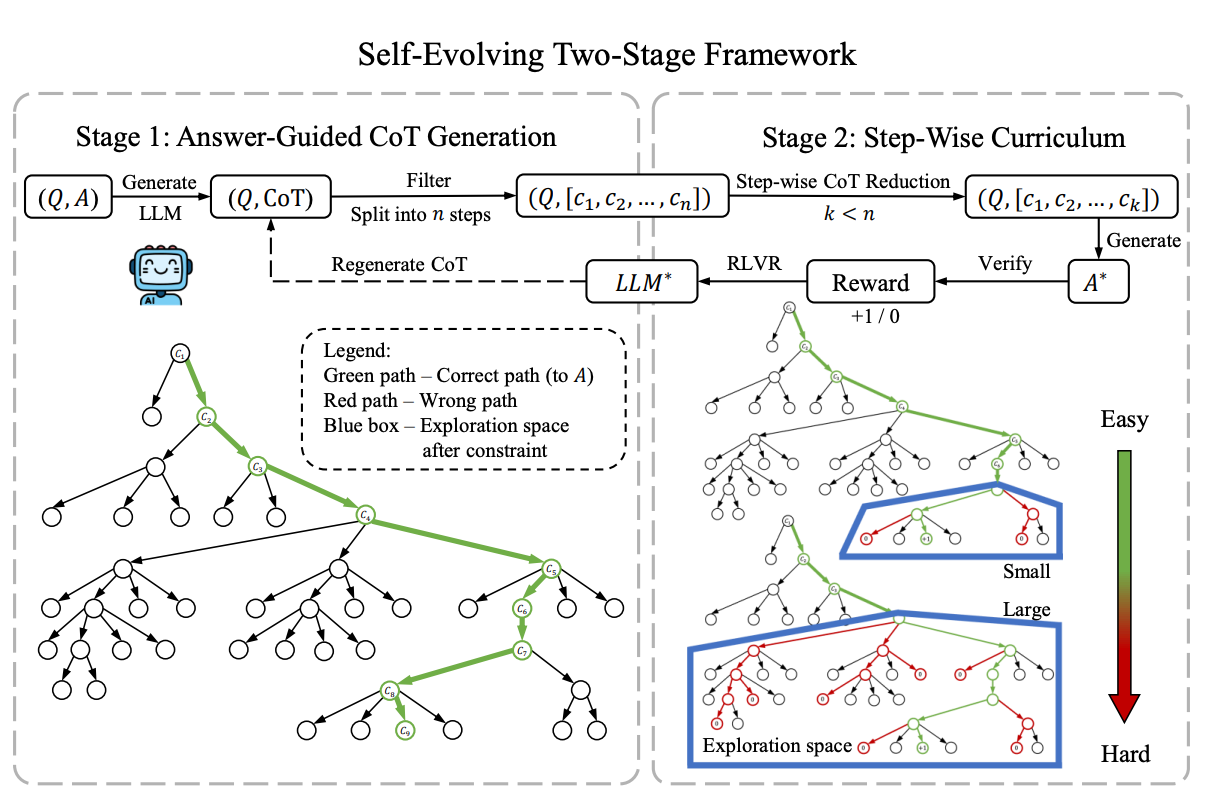
We propose EvoCoT, a self-evolving curriculum learning framework based on two-stage chain-of-thought (CoT) reasoning optimization. EvoCoT constrains the exploration space by self-generating and verifying CoT trajectories, then gradually shortens CoT steps to expand the space in a controlled way. The framework enables LLMs to stably learn from initially unsolved hard problems under sparse rewards. We apply EvoCoT to multiple LLM families, including Qwen, DeepSeek, and Llama. Experiments show that EvoCoT enables LLMs to solve previously unsolved problems, improves reasoning capability without external CoT supervision, and is compatible with various RL fine-tuning methods. We release the source code to support future research.


EvoCoT: Overcoming the Exploration Bottleneck in Reinforcement Learning
Huanyu Liu, Jia Li, Chang Yu, Taozhi Chen, Yihong Dong, Lecheng Wang, XiaoLong Hu, Ge Li
The 64th Annual Meeting of the Association for Computational Linguistics (ACL 2026 Findings) Aug 2025
Reinforcement learning with verifiable reward (RLVR) has become a promising paradigm for post-training large language models (LLMs) to improve their reasoning capability. However, when the rollout accuracy is low on hard problems, the reward becomes sparse, limiting learning efficiency and causing exploration bottlenecks. Existing approaches either rely on teacher models for distillation or filter out difficult problems, which limits scalability or restricts reasoning improvement through exploration.
We propose EvoCoT, a self-evolving curriculum learning framework based on two-stage chain-of-thought (CoT) reasoning optimization. EvoCoT constrains the exploration space by self-generating and verifying CoT trajectories, then gradually shortens CoT steps to expand the space in a controlled way. The framework enables LLMs to stably learn from initially unsolved hard problems under sparse rewards. We apply EvoCoT to multiple LLM families, including Qwen, DeepSeek, and Llama. Experiments show that EvoCoT enables LLMs to solve previously unsolved problems, improves reasoning capability without external CoT supervision, and is compatible with various RL fine-tuning methods. We release the source code to support future research.